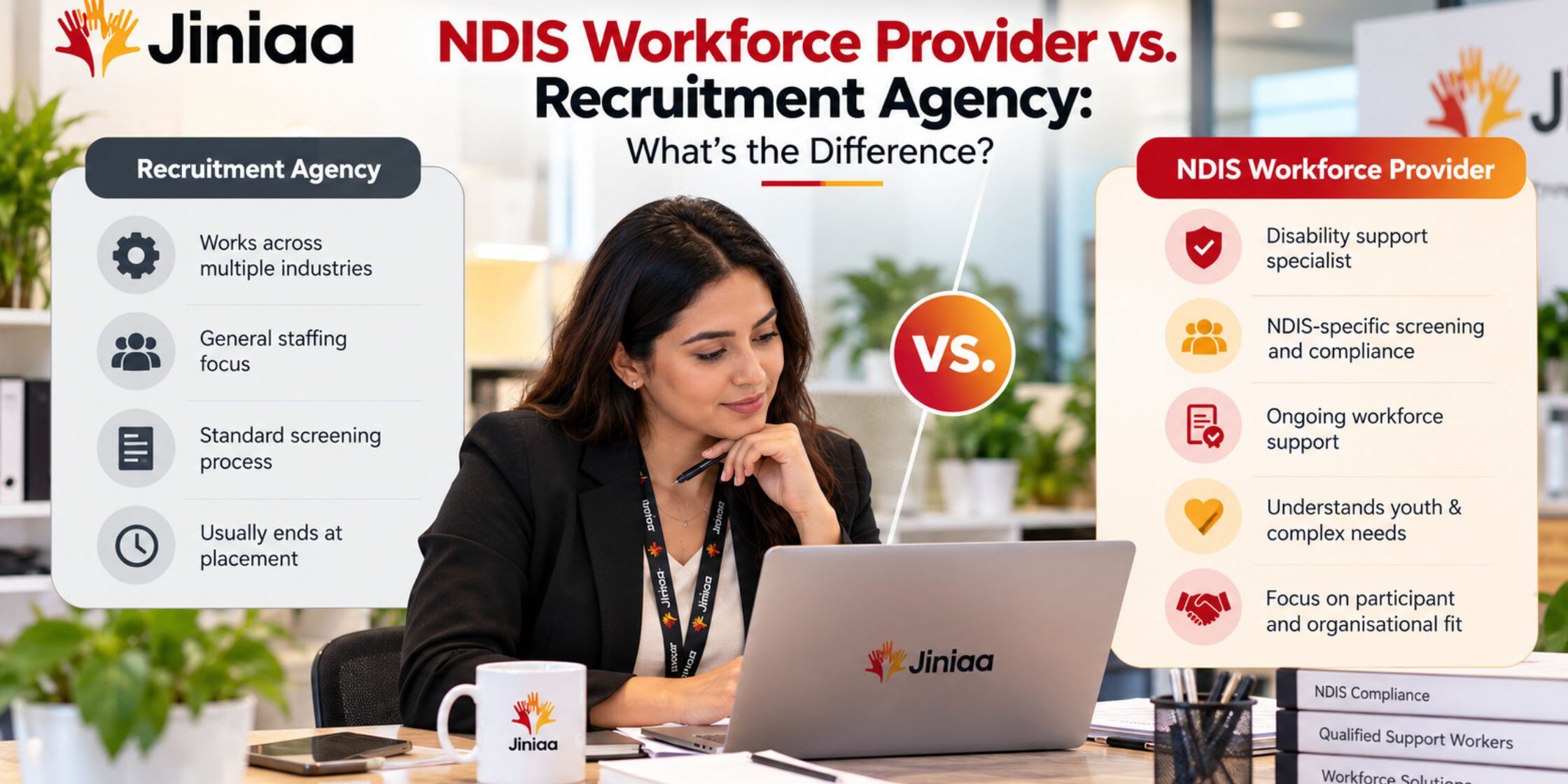
If you run an NDIS-registered organisation, you’ve probably asked yourself: should you partner with an NDIS workforce provider or use a general recruitment agency to find staff? The terms get used loosely, and the two models are often confused — but they work very differently, and the choice has real consequences for compliance, participant safety, and the quality of care your organisation delivers.
Here’s a clear breakdown of the differences, and why it matters for providers delivering disability support across Australia.
What Is a Recruitment Agency?
An NDIS worker recruitment agency is a general staffing business. Its core job is matching candidates to job vacancies across almost any industry — retail, hospitality, admin, healthcare, and sometimes disability support as just one category among many.
Key characteristics of a general recruitment agency:
- Works across multiple industries, not disability-specific
- Focuses primarily on filling a role quickly
- May have limited understanding of the NDIS Practice Standards, Code of Conduct, or Workforce Capability Framework
- Screening is usually generic (resume, basic reference checks) rather than tailored to disability support competencies
- Ongoing relationship with the worker typically ends once placement is made
For a one-off hire in a non-specialised role, this can work fine. But disability support isn’t a generic role — it involves safeguarding, person-centred practice, and regulatory obligations that a general agency may not be equipped to screen for.
What Is an NDIS Workforce Provider?
An NDIS workforce provider is a specialist organisation built specifically around the disability sector. Rather than treating support work as just another job category, it’s purpose-built to understand:
- NDIS Quality and Safeguards Commission requirements
- Worker Screening Check and NDIS Code of Conduct obligations
- The practical, day-to-day realities of participant-facing roles
- How to match support workers to participants based on compatibility, not just availability
A dedicated NDIS support workforce partner typically offers:
- Sector-specific screening — Workers are assessed against disability-specific competencies, not just generic job criteria.
- Compliance-first processes — Worker Screening Checks, qualifications, and Code of Conduct training are built into onboarding, not treated as an afterthought.
- Ongoing workforce support — Many workforce providers support rostering, shift coverage, and staff development on an ongoing basis, not just a one-time placement.
- Understanding of specialised cohorts — A genuine NDIS youth services provider will know how youth and early-intervention support differs from adult disability services, and staff accordingly.
- Cultural and participant fit — Matching isn’t just about availability; it’s about values alignment, communication style, and the ability to build trust with participants and families.
Why the Difference Matters for Your Organisation
| Factor | Recruitment Agency | NDIS Workforce Provider |
| Industry focus | General, multi-sector | Disability support only |
| Screening depth | Standard checks | NDIS-specific screening and compliance |
| Ongoing relationship | Ends at placement | Continues through rostering and support |
| Understanding of Code of Conduct | Variable | Built into process |
| Youth/specialised services | Rarely specialised | Often has dedicated youth/complex-needs expertise |
For providers under scrutiny from the NDIS Commission, or those managing participants with complex or higher-risk support needs, this difference isn’t academic — it directly affects audit outcomes, incident rates, and participant trust.
Making the Right Choice
If you need a short-term, low-complexity hire, a general agency might get the job done. But if you’re building a sustainable, compliant, and genuinely person-centred NDIS support workforce — including staff for youth services, complex care, or high-turnover rosters — a specialist NDIS workforce provider is almost always the stronger long-term partner. It reduces compliance risk, improves participant continuity, and takes the administrative burden of sector-specific screening off your plate.
This is the gap Jiniaa is built to fill — connecting NDIS providers with a screened, compliant, disability-sector-specific workforce, including dedicated support for youth services and complex-needs rostering.
Frequently Asked Questions
Q: Is an NDIS workforce provider the same as a recruitment agency?
No. A recruitment agency is a general staffing business that fills vacancies across many industries. An NDIS workforce provider specialises exclusively in disability support, with built-in compliance, screening, and sector knowledge that general agencies typically don’t have.
Q: Do NDIS workforce providers handle Worker Screening Checks?
Yes — reputable NDIS workforce providers build Worker Screening Checks, Code of Conduct training, and relevant qualifications into their onboarding process, rather than leaving it to the hiring organisation to verify separately.
Q: What makes an NDIS youth services provider different from a general disability support provider?
A dedicated NDIS youth services provider understands the specific needs of younger participants, including early-intervention approaches, family engagement, and age-appropriate communication — skills that differ meaningfully from adult disability support.
Q: Can a small NDIS provider benefit from using a workforce provider instead of hiring directly?
Yes. Smaller providers often lack the internal resources to run sector-specific screening and compliance checks at scale. A workforce provider can supply pre-screened, compliant staff on demand, which reduces administrative load and hiring risk.
Q: How do I know if a workforce provider is genuinely NDIS-specialised versus a rebranded recruitment agency?
Ask about their screening process, whether they train staff on the NDIS Code of Conduct, how they match workers to participant needs, and whether they offer ongoing rostering support — not just one-off placements. A genuine NDIS support workforce partner will have clear, detailed answers to all of these.
Conclusion
Choosing between a generalist recruiter and a dedicated NDIS workforce provider ultimately comes down to what you’re optimising for—a quick placement or a compliant, reliable, long-term team that actually understands disability support work. For providers who want peace of mind on compliance, culture fit, and participant outcomes, the specialised route is almost always the stronger investment. Get in touch with our team today to discuss your staffing needs — visit JINIAA or contact us directly to get started.